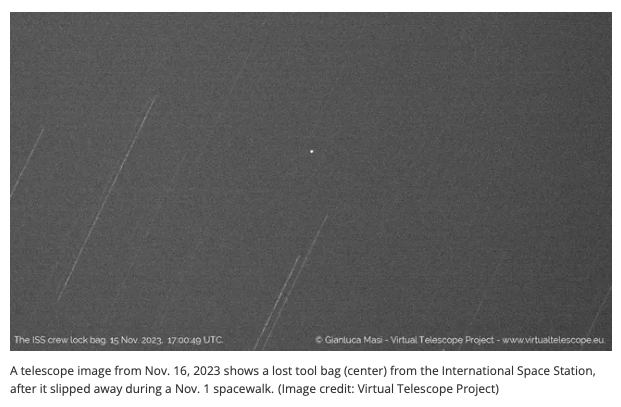
The edifying spectacle of the night sky has become rather less so in recent years as it fills up with satellites and miscellaneous space junk. If you’ve noticed a new dot in the sky this month, it’s a bag of tools which slipped from the grasp of an ISS astronaut doing a spacewalk (see picture).
According to the Union of Concerned Scientists there were 6,718 satellites in orbit (most of them Starlink satellites) at the start of 2023. The North American Aerospace Defense Command (NORAD) tracks 45,000 or so objects in Earth orbit, according to Space-Track.org, down to approx. 5 cm across.
We’re not talking about some aerial counterpart to the scandalous UK freshwater pollution which has been prominent in the news. To stay aloft in low-earth orbit, an object needs to be travelling at over 7,800 m/s. Something the size of a bullet will behave like one if it hits a spacecraft or an astronaut – a bullet travelling four times faster than the fastest high-velocity round on the earth’s surface.
 Whitby Writers Group