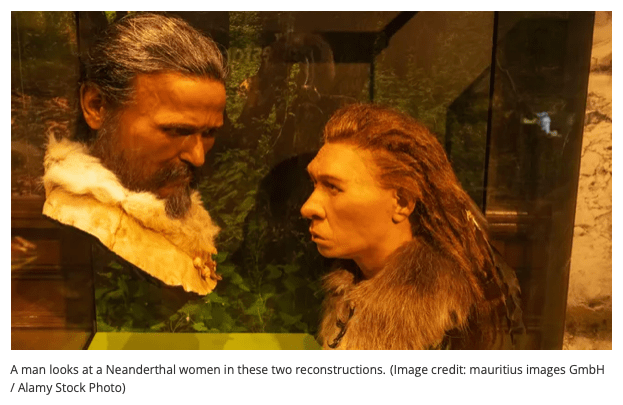
Archaeologist Ludovic Slimak sets out to solve a puzzle: why is Neanderthal DNA to be found in Sapiens (modern human) remains, but no Sapiens DNA in the (plentiful) Neanderthal remains from the time when that species began to go extinct?
Now there’s plenty of possible variants of boy-meets-girl which could explain this one-sidedness, from restrictive marriage customs and the existence of a slave trade to the non-viability of foetuses having a Neanderthal father (c/f horse x donkey), or the strong possibility that the mainly meat-eating Neanderthals had congenital allergies to Sapiens food. Maybe the children of any mixed marriage gladly deserted the Neanderthal lifestyle, which was becoming ever harsher as the climate changed and the traditional large prey animals, mammoths and aurochs, went extinct.
Both Sapiens and Neanderthal made good flint arrowheads. But the Sapiens ones have a similarity suggesting mass-production, or the existence of a specialist craft whose products were traded long-distance. The Neanderthal ones have a variance suggesting that most individuals habitually made their own tools, as would be the rule in predominantly isolated family groups.
It’s bizarre to imagine that what we think of as Sapiens tools might all have been manufactured in factories of enslaved or employed Neanderthals. But far from impossible. We must remember that the Viking sky-gods, the Æsir, did not build their city Asgard themselves, but paid the frost-giants, the jötnar, to come and build it for them.
Nor were the jötnar (better rendered as mountain-dwellers than giants) ignorant ape-men. They may not have been particularly beautiful, but they were prosperous, wise, skilled in craft and magic, and lived in a land called Jötunheimar that was not easy to reach.
 Whitby Writers Group