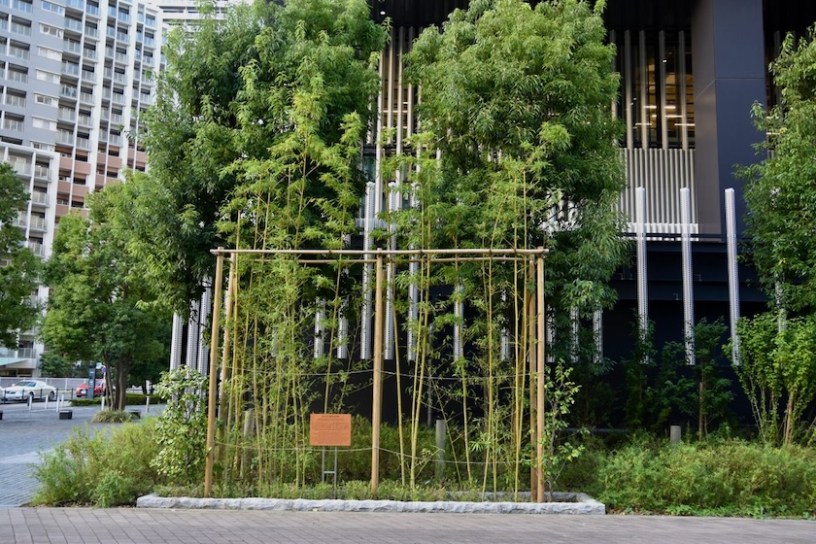
Why is there a stand of bamboo growing in front of the Toshiba Science Museum in Kawasaki?
Because this is very special bamboo. Good for light bulbs.
Now why should bamboo, of all things, be good for light bulbs?
Nowadays just about everything that emits light is powered by LEDs (light-emitting diodes). You need some advanced physics to understand how a LED works (energy levels of electron orbitals in a semiconductor crystal, anyone?) But back in the 19-cent, when people began to guess how super the newly-discovered electricity would be for lighting public buildings and even homes, in place of gaslights and lamps filled with whale oil, electric lamps were much easier to understand.
As (nearly) everyone knows, electricity flowing in a conductor (i.e. a filament of wire) can make it hot enough to glow, or even to shine! But that makes it quickly burn away. The trick is to seal it up in a glass bulb with no air inside. Such a lamp is called an incandescent bulb.
But a serious technical problem stood in the way of practical use.
You’ve stopped the metal filament oxidising (burning away), but the metal atoms are still prone to boiling off the surface and sticking to the glass, and the lamp only lasts a few seconds / minutes / hours. People aren’t going to rush out to buy expensive lamps that rapidly dim and suddenly go dark after an hour or two.
Remedy?
- Use heavy (dense) metals of high melting point, so the atoms don’t launch themselves into space too easily. Osmium and tungsten were favourites: the first is the densest metal known, the second has the highest melting point. The electric light company Osram got its name from its early success in using osmium filaments.
- Use carbon fibres, which are made of long chains of tightly-bound carbon atoms.
The second alternative is the cheapest, if you can make it work. But how on earth did you make carbon fibres in the 19-cent? By kilning fibres made of organic material (wood? cotton? silk? paper?) Out of 2,000 different materials tested by Thomas Edison, a sample of bamboo from the Iwashimizu-Hachimangu Shrine in Kyoto gave the longest lasting filament (1,200 hours).
So there.
 Whitby Writers Group