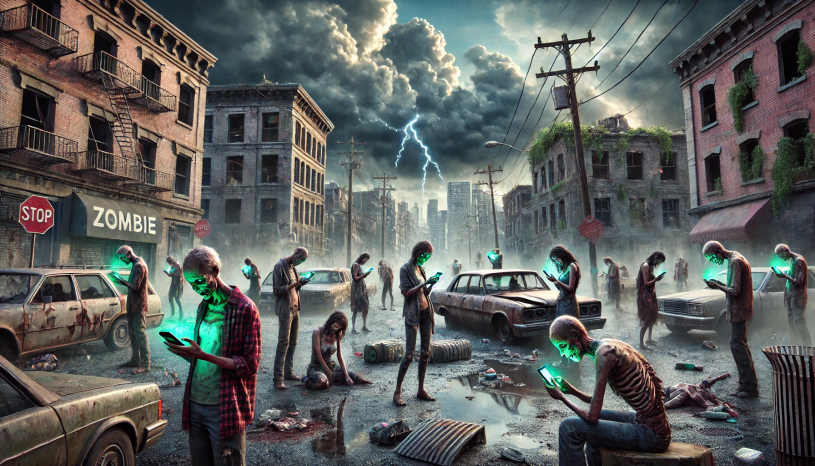
Rebecca Solnit’s essay in The Guardian – Turns out the zombie apocalypse isn’t as fun as they said it would be – strongly resonates with me. She laments the withdrawal of the general public from social interactions in favour of TV and smartphones. It has happened gradually, but is nonetheless dystopian.
But I fancy this is really nothing new. E. M. Forster, writing as early as 1909, describes just about all aspects of an eerily familiar zombified world in his scifi novella The Machine Stops…
As well as Forster predicting globalisation, the Internet, video conferencing and other aspects of 21st-century reality, Will Gompertz, writing on the BBC website on 30 May 2020, observed, “‘The Machine Stops’ is not simply prescient; it is a jaw-droppingly, gob-smackingly, breathtakingly accurate literary description of lockdown life in 2020.”
Then there is Ray Bradbury’s Fahrenheit 451 – another study in extreme social alienation. America’s otherwise-redundant fire departments have been repurposed into a state censorship organisation strongly resembling the DEA but dedicated to incinerating all books, together with their owners’ dwellings. Respectable people exclusively watch TV on wall-to-wall screens in the isolation of their own homes.
 Whitby Writers Group