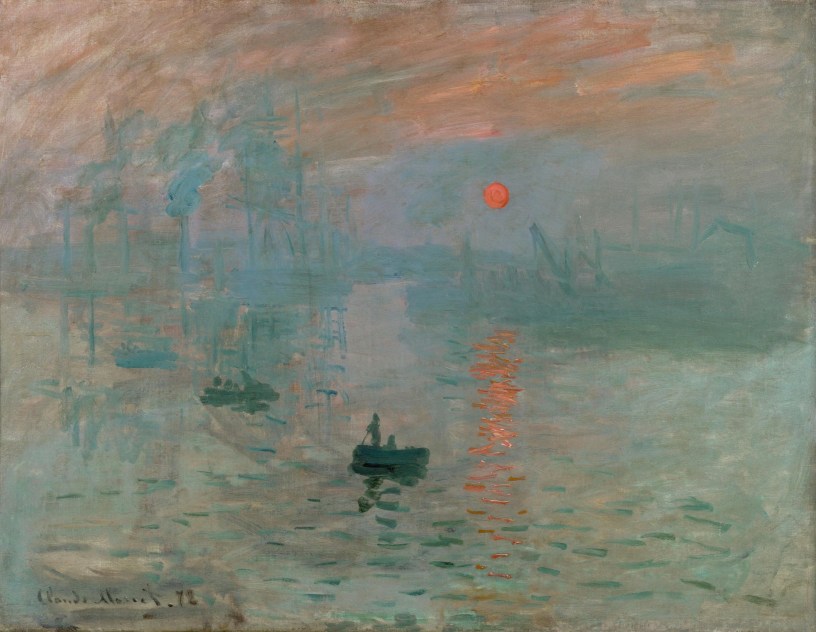
The illustration, Impression, Sunrise, first shown in an “exhibition of rejects” from the Paris Salon, is the picture that kicked off Impressionism. When describing it, the art critic Louis Leroy, writing in Le Charivari, 25 April 1874, was brimming with sarcasm.
[…] What freedom, what ease of workmanship! Wallpaper in its embryonic state is more finished than that seascape.
But it was precisely that lack of finish that preserves an obscure but significant scientific detail that a traditional painter might have lost in translation (from life to canvas). The sun, seen through the polluted fog over the port of Le Havre, is no brighter than the surrounding mirk. The reason we see it at all, both in the picture and in real life, is because of its distinctive hue.
Claude Monet, using the newly-available oil paint that came in squeezy tubes which allowed him to paint out-of-doors with ease, was thus able to capture this phenomenon directly from the real world. Landscape artists typically used watercolour to capture a scene, then took it back to the studio to copy it in oils, adding the much-prized fine detail from memory. Such a solar effect may have been discarded as of no subjective importance.
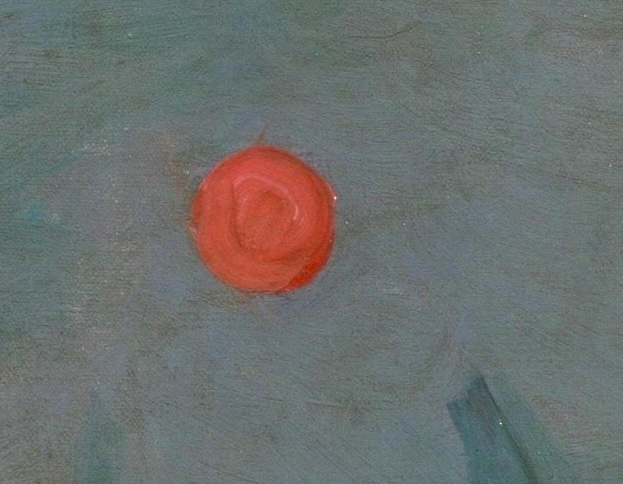
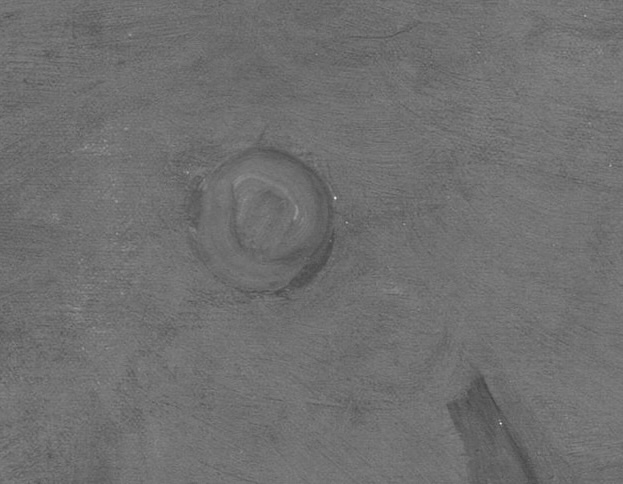
In the above image and its grayscale version, the lower image is derived from the upper by removing the hue, leaving the luminance (the “brightness”) unaltered.
Did Claude Monet know about the underlying science? Maybe not, but he was particularly interested in out-of-doors light phenomena, and was thus well-primed to notice and analyse this particular effect. The entire seascape may well have been conceived just to feature it: hence it’s a reasonable thing to do to de-emphasise most of it in order to focus the viewer’s attention on the sun.
Leroy can thus be excused for being “unimpressed” by the painting as a whole.
 Whitby Writers Group