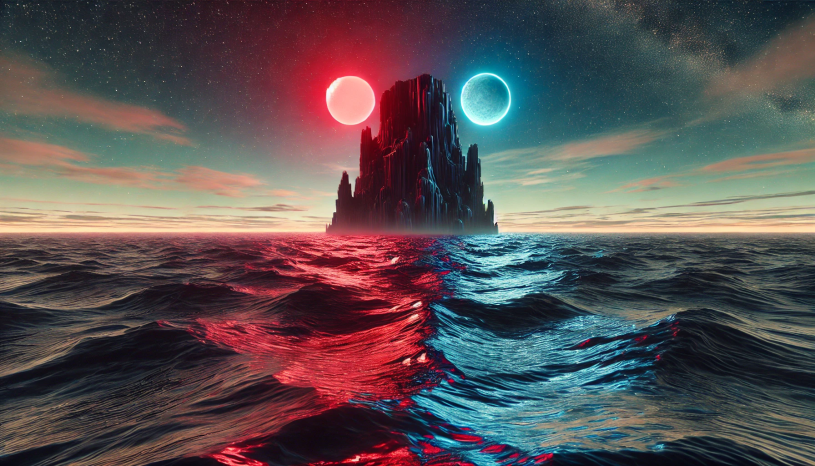
Kris Kelvin, a psychologist, arrives at a space platform orbiting Solaris, an exoplanet in the constellation of Aquarius. A century ago, humanity discovered it possessed intelligent life (but not as we know it) in the form of a sinister ocean covering the entire planet. Since then, mankind’s studies of Solaris have given rise to a rambling academic discipline called Solaristics, which has failed miserably to gain any coherence in its observations of “The Ocean” and its perplexing behaviour.
Kris has officially joined the team at the invitation of Gabarius, his old supervisor. But on arrival he finds that Gabarius has killed himself the day before. The other two scientists, Snaut and Sartorius, clearly have lots to hide and are anything but welcoming.
I’d seen snatches of the Russian film and wasn’t enticed to explore further. But a recent review by a blogger I follow made me reconsider my earlier dismissal. It pointed me towards the only English translation which the author, Stanisław Lem, deemed to be most in the spirit of the original. This I found on Audible, my preferred way of consuming worthy if ponderous works of literature.
Stanisław Lem shows how singularly ill-suited we are to getting into an alien mind. His survey of the “Solaristics” literature is a merciless parody I lapped up, steeped as I am in the published papers and conference proceedings of Applied Psychology. But the amount of it in the book may not be to everyone’s taste. Audible’s only featured review is headed “Boring” – no doubt what you’d think if you had no exposure to research literature. Nevertheless it informs the incidents in the story and it’s best not to skip it, unless you only want the atmosphere and none of the speculation.
The rest of the book is anything but boring. It is atmospheric, creepy and action-packed. It gets you wondering about all those zoology experiments which replay recorded birdsong to birds, or dolphin noises to dolphins.
First published in 1961, we are in the world of neon-lights, a library of printed books, microfilm and tape recorders, “lamps” (thermionic valves/tubes) that need to warm up, and computers in use for little else than ballistic calculations. But if you can resist being distracted by the archaisms (The War of the Worlds comes to mind), it is absorbing and (for me) utterly convincing.
The Ocean (the alien being) is far in advance of anything we can conceive of in the precision it can bring to bear on its task of observing (and modelling) something that has arrived in its sky. But, as with humanity, It is sadly ill-equipped to make sense of what it sees. It quite overlooks the significance of human individuality. After all, it is the only one of its kind. This prompts it to make bad mistakes, which convince its interlocutors (playthings?) of its malice. We are in the Uncanny Valley, in all its gory glory.
In the end, before returning to Earth, Kris attempts the sort of first-contact that ought to have been tried in the first place: the way a child puts out feelers towards something new that might make a rewarding playmate. The Ocean (apparently bearing no grudges) seems disposed to wipe the slate clean. They achieve an elementary meeting of minds: such as you might with a toddler you’ve only just met.
But in the circumstances, what more is possible?
I needed to read the book twice. On my first reading, Snaut’s behaviour seemed paranoid and psychotic. But on second reading, it was a healthy person’s response to the spooky phenomenon of the “guests” – all-too-solid ghosts from your awful past that know so much about you, but not nearly enough to handle you correctly – their avid capacity to learn from you is far from reassuring.
Likewise on first reading, the behaviour of the Ocean seemed deliberately malicious, and its gift of the “guests” the cruellest torment imaginable. But on second reading it clearly conveyed a clear-eyed if completely uninformed attempt at some sort of accommodation with a well-meaning but clumsy agency that had arrived in its firmament. One which it was at first disposed to ignore, but felt obliged to pay some attention to, after the invader had stung it with x-rays in what was so obviously an attempt to probe it.
Stanisław Lem’s book should not be seen as mere entertainment, but a serious contribution to the Exobiology research literature. An allegory, it considers how (not) to approach a powerful rational alien being which starts off with no preconceptions about us. That should be our approach too: to make gifts of information about ourselves, to establish trust and to offer something to trade.
But Snaut’s insight is telling: we aren’t really interested in finding aliens. We’re looking for mirrors: intelligences which show us idealised versions of ourselves.
 Whitby Writers Group