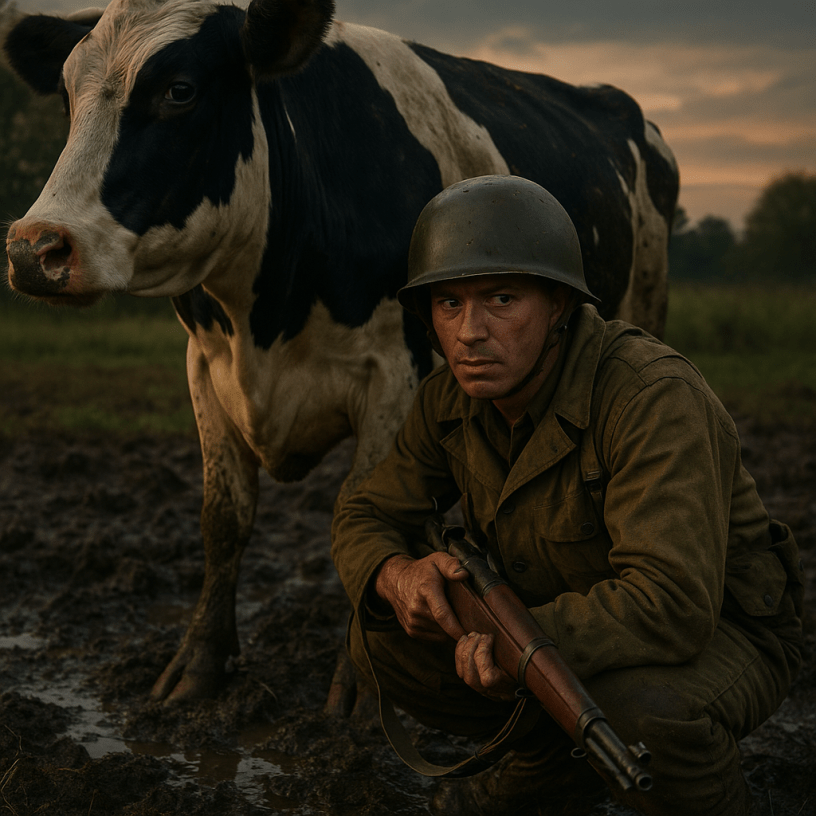
My father was a sergeant-major in the Coldstream Guards. He signed on for 7 years in 1932, aged 19. He was due for demob in 1939, but Hitler put the kibosh on that idea.
Pop killed a lot of enemy soldiers in his time. His pet weapon was the Mills bomb, for which he was an instructor. But he was also trained as a sniper, and indeed ran the Guards Sniper School after he came back wounded from Dunkirk. But one thing used to bubble up in his mind and stop him getting to sleep, if he hadn’t had enough to drink that evening.
Now don’t run away with the idea I’m a deprived child, whose family life was blighted by the demon drink. Pop never hit me – and those were the days when a good father was expected to.
Pop could do no wrong for me, and I enjoyed his company. Even more when he’d had his dose of Reid’s Stout, because he’d loosen up. I wasn’t afraid of him, nor was Mum (they were a devoted couple – “besotted” you could say). I could never understand why a lot of people were afraid of him. People who deserved to be, I might add, but I was too young to know that at the time. He always counted his drinks, and referred to them as “medicine”, joking that it was to keep him “regular”. Being young, and trusting my parents, I accepted that as gospel.
But Pop needed his “medicine” to sleep at night.
It wasn’t anything to do with killing enemy soldiers. Friends=alive. Enemies=dead. That’s what you signed up for. But things can happen to unbalance those simple equations. He never talked to me about the Germans he’d killed, and he’d laughingly dissimulate whenever I probed.
But one incident he did tell me about – more than once, and in some detail. Not that he was proud of it. He wasn’t.
He probably hoped that in my lifetime I might come up with the answer. I haven’t.
At the outbreak of war in 1939 the government set up the Guards Armoured Division, to which Pop was promptly transferred as a CSM / Ford V8 specialist: the engine of the new bren gun carrier. He went over to defend France as part of the British Expeditionary Force. He described himself as one of the “greyhounds” – forever on the run before the advancing Germans. One day he found himself, along with the guards company he commanded, in slit-trenches on the French border. The defensive line continued on into Belgium, where – as you’d expect – the slit-trenches were manned by Belgians.
Now these men didn’t have his training, much less his motivation. Invaders were always stamping about all over their country. After a year or two they’d go away and a new lot would come. You simply got on with your life. No doubt the Belgians were sitting in their trenches in the drizzle, reckoning that if they beetled-off soon they could be home in time for supper.
By late afternoon Pop noticed that Belgian soldiers were creeping out of their trenches and hiding behind the cows, steering them to the edge of the field where they could slip away unseen. He ordered his bren gunner to rake the field with fire, killing all the cows and anyone standing behind them. Nobody ever thought to prosecute him for a war-crime. That was how you dealt with deserters in battle – he’d have been court-martialled if he hadn’t done something to stop the rot.
But he was never able to get the scene out of his mind: dead cows and dead Belgians lying about all over the field, as he told me.
But for all his brave efforts the Germans, high on amphetamine, invaded France by going round the long-prepared defensive Maginot Line via Belgium, and Dad came off the beach at Dunkirk on a stretcher, busted by a jerry spud-masher.
Years later, in the 1980s, hospital staff were very iffy with him when they x-rayed him and saw shrapnel in his back. They thought he must be a gangster. Before they’d treat him as a normal decent human being again, Mum needed to tell somebody where and when he’d collected the shrapnel.
Dunkirk, 1940. “Heard of it?”
The younger staff hadn’t. What had happened in 1940 to make shrapnel fly about? “Haven’t the foggiest – we didn’t do that at school.” The older staff, bless’em, quietly took the younger ones aside and gave them a 30-second history lesson.
“God – you mean we were at war with Germany?!”
But it wasn’t a German stick-grenade that gave Pop his most persistent wound. It was ordering the deaths of friends. Or, to be brutally precise: folk he’d considered friends.
After 12 years service in the British Army, having seen plenty of action, Pop took on a pub. People tend to, I’ve noticed, who’ve killed a lot of their fellow human beings. Albert Pierrepoint, the last public hangman, ran a pub. So did an SAS guy whose book I read once – I forget his name. It allows you to have a good chinwag and a belly laugh with your mates every night, not to say going to bed well-oiled, which helps with the bad dreams.
And it gets you out of bed in the morning, to open up the pub on-time, else face losing your licence.
It also enables you to bribe and corrupt every honest citizen in town: policemen, JPs, chemists… to get the best healthcare they know of. He never needed to humiliate himself by sitting in a doctor’s waiting room (“…and then who’d open up the pub?”) – letting the whole world see the hard-man hero who’d stood up against Hitler now needing help with getting to sleep at nights. He simply bought the chemist a double scotch – and in return the chemist told him what worked.
And what did the chemist say? That he had the most effective medicine of all on the shelves behind his bar. (Which was why the chemist came in for his double scotch each day.)
Pop died of emphysema at the age of 70 from smoking 40 a day. The tobacco killed him before the alcohol did. Though he wouldn’t have admitted to anything killing him except old age – hadn’t he reached his three-score-and-ten?
“Counselling?” he’d say. “Real men don’t go in for counselling.”
Nowadays we recognise the harmful effects of alcohol and tobacco, and prescribe safer alternatives like prozac and diazepam, temazepam, lorazepam… drugs with lots of zzz’s in them to get you to sleep. But we seem to be no further on with helping ex-servicemen live out the fag-ends of their lives, having seen things nobody ever ought to see.
So I’m passing on Pop’s war story like a rusty old unexploded munition, brought home in the kitbag for a souvenir. Do you know how to make it safe?
I don’t.
 Whitby Writers Group
Since writing this, I’ve looked deeper into the matter. I think I’ve been less than fair. For all I know Belgians are as patriotic as anyone else, for all the rapine their land has seen. But this I’ve learned: in 1941 Belgium’s relations with its “allies” Britain and France were at rock-bottom, because the Belgians knew they were only there to absorb a few German bullets.
At the end of the day, if everyone think you’re there and you aren’t, will anyone have noticed? What Pop witnessed – and interdicted – might have been covert troop-redeployment, not mass desertion.
If Pop had known, he might have stayed his hand. After all, weren’t the Coldstreamers there for just the same purpose? If Pop had found out after the War (running a pub, there was nothing people didn’t tell him) it would only tighten the screw.
Soon everyone who knows what happened, or cares, will be dead.
I care. I grew up with this man and his war-wounded conscience. It’s part of me. But I’ll never be one-tenth the man he was.
Tu sais quelque chose sur cette affaire que je ne sais pas?
Do reply to this comment. Doesn’t have to be in English.
LikeLike