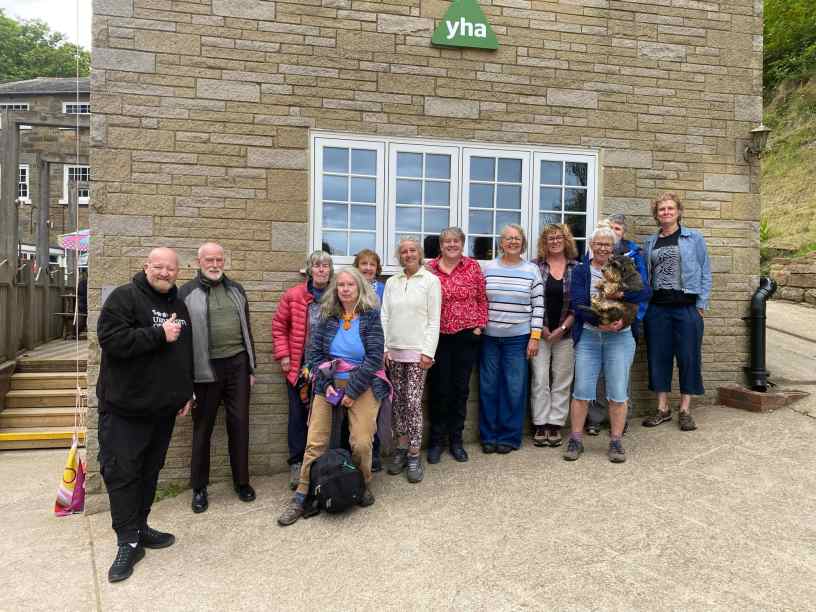
Received from our member Suzanne…
A Way with Words: Boggle Hole Youth Hostel, 10.30 am to 1.30 pm, Saturday 7 June 2025.
Run by Suzanne Elvidge and Steve Hoey, with guest speaker Garry Burnett.
WWG members present: Suzanne, Michele, Adele, Ian.
Writing is easy. All you have to do is to cross out the wrong words.
Mark Twain
–ooOoo–
Warming up with a six-word story
A six-word story is a short narrative that conveys a compete story in just six words. This exercise of concise storytelling challenges writers to distil a story to its core elements and emotional impact.
Ernest Hemingway’s story (allegedly) – ‘For sale: baby shoes, never worn’.
Why do we write stories?
- We can try out being other people
- We can tell stories that might otherwise be lost
- We can get things out of our heads and hearts – a kind of therapy
- People like reading stories
- Writing is fun!
When things get tough it is your why, your motivation that will drive you forward: ‘Procrastination is the death of opportunity.’
Different kinds of stories
- Monologues – stories that are written to be spoken by one voice. They are usually performed to the audience or the camera
- Short stories and flash fiction – usually 1000 words or less, can be as short as 50 words, or even six words
- Plays
- ‘Fragments’ – Looking into the past is like looking into a cracked mirror – fragments may only appear – and contained in my words are the reflections I see. They where about growing up and things I remembered
- Novels
- Memoirs
How do you write?
- You can write daily, weekly, monthly, when you fancy
- You can use your favourite pencils and nice notebooks, laptops, tablets or even your phone
- The only way to get writing done, though is just getting on with it…
Think of an idea
Ideas come from many places
- News, books, magazines, radio, TV, music, landscape, objects, pictures, places
- Overheard conversations
- Jobs you wish you’d done.
- Stories on the internet when you were searching for something completely different…
- What you feel
Using description
Description makes the story much more interesting to listen to – think about sounds, smells, tastes, colours, textures, feelings. You can play with these too – imagine what polished wood smells like, what a cloud tastes like, what sound sunlight would make. What wind would feel like if you could touch it. What the colour of one of these objects would taste like (please don’t lick them…).
Create a character
Your character and their voice are the core of the piece. Their characteristics feed into their voice and word choices – their age, where they are from, when the monologue is set, who they are talking to, their accent and word patterns.
You can start with a creating a character sketch based around the following pointers – you don’t need to use all of them, and not all of the answers will appear in the piece, but it can help you get to know them.
- Name/nickname
- Age
- Where they are from/where they live now?
- How they stand or sit?
- What are they wearing?
- What they have in their pockets/wallet/purse/handbag
- Do they have a job and if so, what is it?
- Do they have hobbies and if so, what?
- What is their level of education?
- What do they feel like at the time of the monologue – sad, happy, lonely, angry etc?
- How do they speak – loud/quiet? Accent?
- What do they like/dislike?
- Do they have secrets?
- Who are their family & friends?
- What is the worst thing they have ever done?
- Do they like themselves?
What shape is a story?
Stories have a beginning, a middle and an end. The beginning needs to catch the reader, and the end needs to leave them somewhere – with a sense of conclusion, or a question of what is going to happen next. It’s like a three-act play.
Using repetitions, alliteration (repeated sounds at the starts of words – the sweet sparrow sang) and assonance (similar vowel sounds (kite flies high) gives a piece shape and rhythm. A twist at the end gives your audience a surprise.
Things to think about:
- Tone – is the monologue serious, quirky, funny?
- Length – stories can be long or short, from a few lines to a couple of pages.
- Where is your character – at home? At work? In a bar? In space?
- When is your story set – is it now or is your character historical?
- Is the monologue about something happening in real time, or is it a flashback? Or both?
- Does your character want something and there’s a barrier?
- Does your character change/go on a metaphorical journey?
- Is there a twist?
Editing and rewriting
An important step – go through the story, rewrite it, add in extra layers, extra descriptions, extra senses. Read it out loud to see how it feels. It’s a good way to find extra-long sentences and words that make you stumble.
Remember progress, not perfection!
What to do with your story
You can keep your writing just for you, you can show it to a few people, you can share it far and wide. It’s your story.
- Read writing magazines and websites for places to submit – magazines, anthologies, competitions
- If you write for performance, look for scratch nights, spoken word and open mic events, talk to local amateur theatre companies
- Create a blog or post on social media
- Submit to local magazines like the Esk Valley News Quarterly
- Join a writer’s group
 Whitby Writers Group